
Problem Set III Answers
Biochem 200
Kaiser/Harbury
Aerobic Metabolism
1. (a)
Pyruvate + NADH + H+ ---> Lactate + NAD+
D
G0’ = -6 kcal/mol
Recall that H+ is expressed in the concentration units of the standard state. For
DG0’, the standard state is pH 7. Thus an H+ concentration of 10-7 M is expressed as a concentration of 1 in the above equation. Rearranging terms:
Thus at constant pH, the ratio of lactate to pyruvate is directly proportional to the ratio of NADH to NAD+.
(b) Elevated levels of  as a result of ethanol consumption would decrease the pyruvate concentration in the cell. Because conversion of pyruvate to phosphoenolpyruvate is the rate-limiting step of gluconeogenesis, decreased pyruvate concentrations would reduce the rate at which glucose is produced by the liver.
(c) Glycogenolysis to generate glucose can compensate for defects in gluconeogenesis. Because glycogen reserves are depleted after ~24 hours of fasting, a malnourished individual, or one who has missed several meals, is much more susceptible to ethanol-induced hypoglycemia.
2. (a) The oxaloacetate or malate allows the TCA cycle to proceed, generating NADH. The NADH feeds into the electron transport chain, which ultimately reduces O2 to H2O.
(b) The oxaloacetate/malate acts catalytically. The fuel for the TCA cycle is acetyl CoA, which in this case probably comes from the breakdown of fatty acids. Thus a small amount of oxaloacetate/malate can catalyze the consumption of a large quantity of acetyl CoA.
3. (a) High levels of ADP activate PFK by competing with the allosteric inhibitor ATP. High levels of ADP signal that the cell needs ATP. Activation of PFK feeds more pyruvate into the TCA cycle, increasing the rate of ATP production.
(b) Low blood glucose causes the release of the hormone glucagon from the
a-cells of the pancreas (Theriot lectures). Glucagon activates cellular adenylate cyclase, increasing [cAMP]. High cAMP concentrations cause the release of the regulatory domain from protein kinase A (PKA), which subsequently phosphorylates the bifunctional enzyme PFK2/Fru 2,6 bisphosphatase. Phosphorylation of the bifunctional enzyme activates the phosphatase activity and blocks the kinase activity. Consequently, concentrations of the allosteric regulator fructose 2,6-bisphosphate drop. Because fructose 2,6-bisphosphate activates PFK, a drop in fructose 2,6-bisphosphate concentration results in decreased PFK activity. Thus, under conditions of glucose starvation, the rate at which glucose enters glycolysis through PFK is reduced, allowing the liver to net produce glucose by gluconeogenesis rather than net consume glucose by glycolysis.
4. Nitrites oxidize Fe2+ in hemoglobin to Fe3+ (methemoglobin). Fe3+ binds tightly to cyanide. Thus, the body’s large pool of iron in the form of hemoglobin can be used to absorb and detoxify cyanide, which would otherwise bind to the heme a3 in cytochrome oxidase and lethally inhibit oxidative phosphorylation.
5. (a) Malate conversion to oxaloacetate:
Malate + NAD+ ---> Oxaloacetate + NADH + H+
D
G0’ = 7.18 kcal/mol (5*10-6)
(b) Rearranging (remember that an H+ concentration of 10-7 M is expressed as a concentration of 1 in the above equation):

Thus [oxaloacetate] = 10*1*0.2*10-3/192,000 = 1*10-8 molar.
(c) Recall that 1 liter is 1 cubic decimeter (a decimeter, dm, is a tenth of one meter). The volume, V, of the mitochondria is:

The oxaloacetate concentration is 10 nanomolar, or 1*10-8 molar. Thus, the total moles of oxaloacetate, M, is:
M = 1*10-8 moles/liter * 4*10-15 liters = 4*10-23 moles
Multiplication by Avagadro’s number, N (N= 6*1023 molecules/mole), gives the number of oxaloacetate molecules:
#oxaloacetate molecules = 6*1023 molecules/mole * 4*10-23 moles = 24
6. (a)
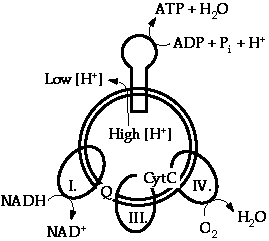
If these particles are incubated with NADH, protons would flow to the inside of the vesicle, establishing an internally higher proton concentration. ATP synthesis would occur on the outside of the vesicle, as protons pass from inside to outside through the channel of the ATP synthase.
(b) Both ADP and O2 are required for ATP synthesis.
(c) Dinitrophenol (DNP) is a weak acid that is soluble in the inner mitochondrial membrane. DNP ferries protons from the inside of the vesicle, across the vessicle membrane, and releases them outside the vesicle. Thus the proton gradient generated by electron transport can be dissipated by DNP. Under these conditions, the proton gradient is uncoupled from ATP synthesis by the F0F1 ATP synthase (which then has no power source!).
7. Electron carriers.
|
Q |
Heme b |
Heme c1 |
Heme c |
Heme a |
|
|
(a) |
R |
R |
R |
R |
O* |
|
(b) |
R |
R |
R |
R |
R |
|
(c) |
O |
O |
O |
O |
O |
|
(d) |
O |
O |
O |
O |
O |
R = reduced; O = oxidized; *CN- binds Fe3+ which is the oxidized form of heme a3.
8. Electrochemical proton gradients.
(a) External medium [H+] = 10-7.4. Matrix [H+] = 10-7.7.
(b)  . Consider the reaction:
 --->
---> 
For this reaction,  with
with
D
G = 0 + RT*ln{1/2} = -0.42 kcal/mol
(c) The volume of the mitochondria, V, is evaluated:

Thus,
#protons = 10-7.7 moles/liter * 1.8*10-15 liters * 6*1023 molecules/mole = 22
(d) 3*-0.42 kcal/mol = -1.3 kcal/mol, which is insufficient to drive ATP synthesis from ADP + Pi + H+ (
DG0’ = 7.5 kcal/mol).
(e) The free energy for proton transport across the membrane is larger than 0.42 kcal/mol because of the transmembrane electric potential. The electric potential arises from an excess of positive charges in the cytosol and an excess of negative charges in the matrix.
9.
10. (a) Conversion of Glu 6P into Rib 5P:
4 Glu 6P ---> 4 Fru 6P
(phosphoglucose isomerase)
1 Glu 6P + ATP ---> 2 Glyceral 3P + ADP + H+
(top half of glycolysis)
4 Fru 6P + 2 Glyceral 3P ---> 2 Xyulose 5P + Ribose 5P
(transketolase/transaldolase running backwards)
2 Xyulose 5P ---> 2 Ribose 5P
(phosphopentose epimerase/phosphopentose isomerase)
----------------------------------------------------------------------------------------------------------------------------------------------------------------
5 Glucose 6-phosphate + ATP ---> 6 Ribose 5-phosphate + ADP + H+
(b) Full oxidation of Glu 6P to generate NADPH.
6 Glu 6P + 6 H2O + 12 NADP+ ---> 6 Xyulose 5P + 12 NADPH + 12 H+
(Oxidative branch of Pentose Phosphate Pathway)
2 Xyulose 5P ---> 2 Ribose 5P
(phosphopentose epimerase/phosphopentose isomerase)
4 Xyulose 5P + 2 Ribose 5P ---> 4 Fru 6P + 2 Glyceral 3P
(transketolase/transaldolase running forwards)
4 Fru 6P ---> 4 Glu 6P
(phosphoglucose isomerase)
2 Glyceral 3P + H2O ---> Glu 6P + Pi
(top half of glycolysis/gluconeogenesis)
-----------------------------------------------------------------------------------------------------------------------
Glucose 6-phosphate + 12 NADP+ + 7 H2O --->
6 CO2 + 12 NADPH + 12 H+ + Pi