Problem set III
Biochem 200
I . Indicate whether each statement below is true or false, concerning the following series of enzyme catalyzed reactions (carried out at pH 7).
L --> M --> N --> 0 --> P
ii. The value of AG' tells us how far from equilibrium a reaction is under prevailing
conditions.
iii. The enzyme catalyzing the step 0 --> P changes the value of D GO' for the reaction.
iv. The higher the absolute value of D G', the faster the rate of the reaction.
V.
The values of D GO' for each of the individual reactions can be added to give thevalue of D GO' for the overall reaction L --> P.
The following formulas may be helpful (where' indicates reaction at pH 7):
D G' = D GO' + 5.927 log10 Q Q = [products]/[reactants]
D GO' = -5.927 log10 Keq'.
a) What is the value of the equilibrium constant for the isomerization of glucose 6
phosphate to fructose 6-phosphate? What is the value of D GO' for this reaction?
b) What information would you need to determine the value for D G' for this reaction
in a red blood cell?
c)
Suppose that you repeat the experiment with the solution of fructose 6-phosphate,but you omit the enzyme. How will this omission affect the equilibrium value for the
conversion of fructose 6-phosphate to glucose 6-phosphate? Why is it unlikely that you
would be able experimentally to determine the value of the equilibrium constant in the
absence of phosphoglucose isomerase?
3. Listed with each of the following reactions is the respective standard free energy
change:
UTP + H20 UMP + PPi D GO'= - 33 kJ/mol
Glucose- I -P + H20 glucose + Pi D GO'= - 12 kJ/mol
PPi + H20 2 Pi D GO'= - 21 kJ/mol
UDPG + H20 --> UMP+Glucose-l-P D GO'= - 25 kJ/mol
Calculate D GO' for the reaction
Glucose-l-P+UTP+H20 UDPG + 2 Pi
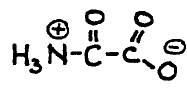
4. You and your laboratory partner are studying this molecule, called oxamate.
You have already found that it inhibits glycolysis. Experimentally, you add oxamate and glucose to a cell-free extract of muscle and incubate in the absence of oxygen. Compared to a control experiment carried out in the absence of oxamate, you note an accumulation of glyceraldehyde 3-phosphate, dihydroxyacetone phosphate, and fructose 1,6-bisphosphate at the end of the incubation. Smaller amounts of phosphoenolpyruvate and pyruvate are present, but there is no lactate. Your partner proposes that glyceraldehyde 3-phosphate dehydrogenase is inhibited by oxamate.
However, you suspect that another enzyme might be affected. You repeat the experiment but this time you add a large excess of NAD+. Now, there is no accumulation of glyceraldehyde 3-phosphate, dihydroxyacetone phosphate, or fructose 1,6-bisphosphate. Instead, pyruvate accumulates in the extract. Your partner gracefully agrees that another enzyme is inhibited by oxamate. Which enzyme is it likely to be? Briefly explain the different results of the two experiments.
5. Hexokinase catalyzes the first step in glycolysis: phosphorylation of a -D-glucose
to yield a -D-glucose 6-phosphate.
Brain hexokinase can catalyze the phosphorylation of glucose, fructose, and several other hexoses. The Km for glucose is 10-5 M, while it is 10-3 M for fructose. Maximum velocity for glucose 6-phosphate formation is 2 x 10⁻⁵ mol/min; Vmax for fructose 6-phosphate formation is 3 x 10⁻⁵ mol/min. Observed rates of hexose phosphorylation in brain are 10-5 mol/min for glucose and 10-8 mol/min for fructose.
a) Use the following (Michaelis-Menten) equation to estimate the concentrations of
glucose and fructose in a brain cell.
V= Vmax [SI
[S] + Km
where V is the reaction rate, and [S] is the substrate concentration
b) According to the information provided, is glucose or fructose more important in
the generation of metabolic energy in brain? Why?
c)
Although the hexokinase reaction is the first step in glycolysis and is essentially irreversible, the enzyme is not the key regulatory enzyme for the pathway. Instead, relative levels of phosphofructokinase activity are crucial for the control of flux through glycolysis. Give a likely reason that hexokinase is not used by cells as a control element for glycolysis.
d) Recall that the glucose Km for hexokinase is 0.01 m.M, while for glucokinase it is
6 m.M.
i) Explain why hexokinase is useful to a neuron during a period when the level of glucose entering that cell is relatively low.
ii) Explain why glucokinase is useful to a liver cell during a period when the level of glucose entering that cell is relatively high.
6. Epinephrine stimulates muscle glycogen breakdown by binding to a specific
hormone receptor. The receptor then activates adenylate cyclase. Active adenylate
cyclase catalyzes the synthesis of cyclic AMP, which in turn activates a protein kinase.
Glycogen phosphorylase catalyzes the phosphorolysis of glycogen:
Glycogen + Pi ---- > Glucose I -phosphate+ Glycogen
(n residues) (n- I residues)
Glycogen synthase catalyzes the synthesis of glycogen:
UDP-glucose + Glycogen ---- > Glycogen + LJDP
(n residues) (n + I residues)