Selected movies from the Theriot Lab.
Life history of a single infecting Listeria
monocytogenes
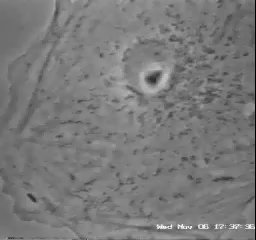 The sequence begins with the
bacterium at the lower left corner of the cell, still in the
membrane-bound compartment. It breaks free from the membrane
and divdes several times before the movement begins. Once
movement begins, the descendants of the initial infecting
bacterium spread through the whole cell very quickly. Speeded
up 900X.
The sequence begins with the
bacterium at the lower left corner of the cell, still in the
membrane-bound compartment. It breaks free from the membrane
and divdes several times before the movement begins. Once
movement begins, the descendants of the initial infecting
bacterium spread through the whole cell very quickly. Speeded
up 900X.
--Julie Theriot & Dan Portnoy
Listeria monocytogenes moving in PtK2 cells
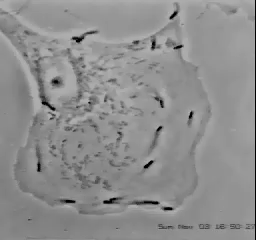 These pathogenic bacteria grow directly in the host cell cytoplasm. The phase-dense streaks behind the bacteria are the actin-rich comet tails. Actin-based motility is also used in cellular motility; this cell is using it's cytoskeleton to crawl toward the lower right-hand corner. Speeded up 150X over real time.
--Julie Theriot & Dan Portnoy
Shigella flexneri associated with actin tails in
PtK2 cells
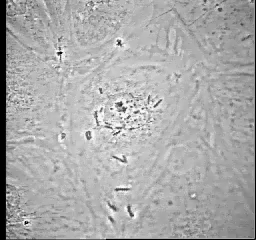 These bacteria are unrelated to L. monocytogenes but move at similar rates and with similar behaviors. S. flexneri are substantially larger than L. monocytogenes and because of this the tails appear to be phase-lucent rather than phase-dense. Speeded up 300X.
--Julie Theriot & Marcia Goldberg
Shigella flexneri with a deletion for icsA infecting cells
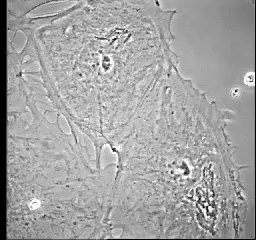 Mutant S. flexneri with a deletion in icsA. These bacteria invade cells normally and grow normally in cytoplasm, but do not associate with actin and do not move. Instead, they form microcolonies in infected cells. Speeded up 200X.
--Julie Theriot & Marcia Goldberg
Candida albicans killing macrophages from the inside-out
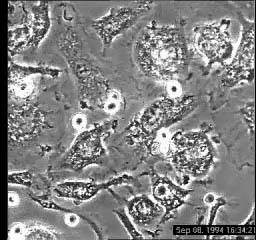 Candida albicans, a fungal
pathogen, being consumed by mouse bone marrow macrophages.
After the macrophages engulf the yeast-like C. albicans,
the fungus responds by rapidly growing a "germ tube." This
projection eventually pierces the macrophage from the inside,
killing the attacking macrophage, while the fungus survives.
Speeded up 900X.
Candida albicans, a fungal
pathogen, being consumed by mouse bone marrow macrophages.
After the macrophages engulf the yeast-like C. albicans,
the fungus responds by rapidly growing a "germ tube." This
projection eventually pierces the macrophage from the inside,
killing the attacking macrophage, while the fungus survives.
Speeded up 900X.
--Julie Theriot & Julie Koehler
Salmonella typhimurium invading a fibroblast cell
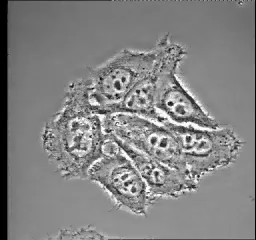 Salmonella typhimurium invades
Henle human epithelial cells. Contact of the bacteria on the
host cell surface causes the host cell to send up huge
actin-rich ruffles or "splashes" that engulf the bacteria as
they fold back over. The bacteria are then trapped inside large
vacuoles and replicate there. Speeded up 450X
Salmonella typhimurium invades
Henle human epithelial cells. Contact of the bacteria on the
host cell surface causes the host cell to send up huge
actin-rich ruffles or "splashes" that engulf the bacteria as
they fold back over. The bacteria are then trapped inside large
vacuoles and replicate there. Speeded up 450X
--Julie Theriot & Jorge Galan
Vibrio cholerae colonizing human cells
 Vibrio cholerae colonize the
surface of HEp-2 human carcinoma cells. As more bacteria adhere
to the host cell surface and secrete cholera toxin, th host
cells begin to pump out water and salt due to constitutive
activation of adenylyl cyclase. In the intesine, the water is
pumped into the intestinal lumen, resulting in watery diarrhea.
Speeded up 300X.
Vibrio cholerae colonize the
surface of HEp-2 human carcinoma cells. As more bacteria adhere
to the host cell surface and secrete cholera toxin, th host
cells begin to pump out water and salt due to constitutive
activation of adenylyl cyclase. In the intesine, the water is
pumped into the intestinal lumen, resulting in watery diarrhea.
Speeded up 300X.
--Julie Theriot & Claudette Gardel
Listeria monocytogenes moving in Xenopus
extract
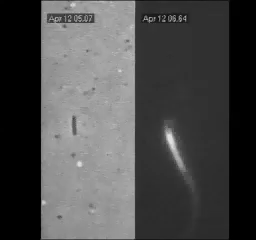 Listeria monocytogenes bactera
moving in a cytoplasmic extract. On the left is the
phase-contrast sequence to show the bacterium moving. On the
right is a simultaneously recorded fluorescence sequence,
showing the distribution of fluorescently-labeled actin.
Speeded up 60X.
Listeria monocytogenes bactera
moving in a cytoplasmic extract. On the left is the
phase-contrast sequence to show the bacterium moving. On the
right is a simultaneously recorded fluorescence sequence,
showing the distribution of fluorescently-labeled actin.
Speeded up 60X.
--David Fung
Motility initiation of Listeria
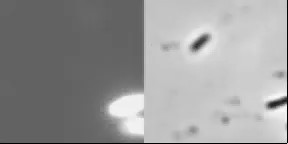 How do Listeria start
moving? This movie shows a bacterium's journey from no
actin to a full-fledged comet tail in Xenopus
extract. Speeded up 60X.
How do Listeria start
moving? This movie shows a bacterium's journey from no
actin to a full-fledged comet tail in Xenopus
extract. Speeded up 60X.
--Susanne Rafelski & Julie Theriot
Keratocyte actin-based motility.
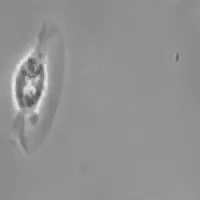 A fish keratocyte, recently freed from the confines of a goby scale, crawls rapidly using actin-based motility. Speeded up 30X
--Rachael Ream, George Somero & Julie Theriot